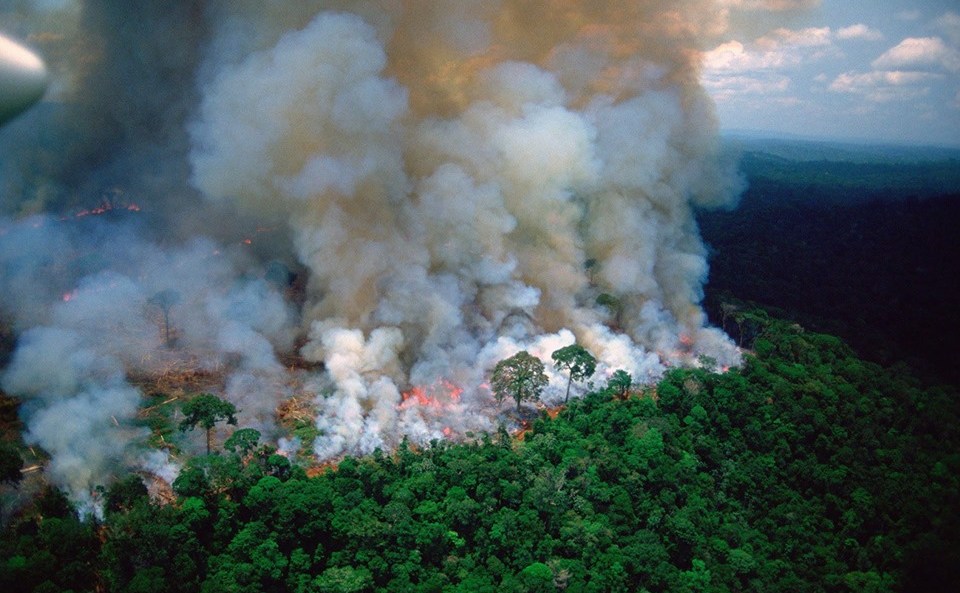
In 1965, the then-Brazilian government issued a national ban on slash-and burn farming, which had become a clear and immediate cause of deforestation in the fifth-largest country in the world, and home to the majority of an area which, in coming years, may prove necessary to our survival.
During the introduction of Brazil’s 1964 Forest Code and the coming decades, the political structure of the country was viciously unstable. At the time the country was barely being held together after a US-backed military coup attempted to oust João Goulart from power. The result was a military junta which ruled the country until 1980, under the shadow of the Cold War and international diplomacy. The “economic miracle” of the 1970s – spurned by the US’ endless hunger for oil and growing agricultural economies – was a particular reason for the junta’s longevity.
Throughout all this time, and the tumultuous scenes of Brazil’s government up until the election of the far right-wing Jair Bolsonaro at the beginning of this year, the future of the Amazon and its inhabitants has been an international issue. On face value, the Brazilian government holds responsibility in protecting the largest bio-diverse environment left on the planet. But in truth, Brazilian leaders have turned their back on the gradual destruction of the Amazon. In fact, its likely that many of them are the reason its burning in the first place.
Slash-and-burn farming has been a factor in Brazil since their independence, and long before. Humans have practiced slash-and-burn – the act of cutting own trees, letting them dry and then burning them to create high-nutrient soils for farming – was potentially practiced since human migration, with Julius Caesar noting on the need for slash-and-burn farmers to continuously find new land in his Commentarii de Bello Gallico. The native inhabitants of the Amazon have also been practicing the technique for as long as anyone can remember. But there’s slash-and burn, and then there’s slash-and burn. While traditional technique called for a small portion of land to be cleared, only to be rotated with other crop areas over years, modern demands on farmers, loggers and land owners to clear in the face of a voracious international appetite for resources has changed the paradigm.
Thankfully, with the eventual phasing out of feudalism and migratory farming in the face of growing land ownership and citizenry, slash-and-burn farming gave way to more modern practises, largely focussed on protecting and cultivating land which could potentially be passed down through many generations. Growing knowledge in fertilization and conservation now tells us just how damaging slash-and-burn can be.
In the giant grey area that is Brazilian political and environmental policy, though, slash-and-burn has continued despite this knowledge. The Brazilian government has known for decades that, despite a national law demanding the end to the destruction, clearing has only increased. Brazil is home to over 208 million people and has intrinsic trade agreements throughout the world. Brazil has been the world’s largest coffee producer for 150 years; it’s also one of the largest producers of oranges, sugar cane soybeans and more. By far, the largest cause of clearing since the 60’s has been cattle ranching, the core of Brazil’s now huge beef export market. In contrast, the country’s capital Brasilia and largest cities São Paulo and Rio de Janiero largely focus on manufacturing, something which has long been held by the country’s leaders as an economic backbone of the country.
What isn’t talked about is how wrecked this economy is. In 2002, Brazil borrowed US $30.4 billion form the International Monetary Fund, then a record amount. All the while Brazil hosts one of the biggest wealth inequality margins in the world. According to a 2013 Latin Business Chronicle article, corruption accounts for US $40.1 billion in lost revenue every year. Last year, 62 per cent of the Brazil’s population said corruption was the biggest problem in the country.
Sadly, this all goes hand-in-hand with the wellbeing of the Amazon, and it shows. In 2011 the Brazilian government relaxed laws on clearing the Amazon, including providing amnesty to those who illegally cleared since the start of the Forest Code. With 20 per cent of the Amazon already gone it was clearly seen as a disaster by conservationists.
Eight years on and with exponentially more terrifying information about the fragility of our planet available, it’s only gotten worse. São Paulo has been blanketed in smog, making the city look like it’s midnight in the middle of the day. When the director of Brazil’s National Institute for Space Research (INPE) Ricardo Galvão reported an 88 per cent increase in the deforestation rate of the Amazon compared to last year, Bolsonaro sacked him. Jair Bolsonaro, for context, has also made his son the ambassador to the US, and recently told a crowd of international journalists that he was on a “mission from God” to modernize Brazil. Oh, he also accused the NGOs who have been reporting on the massive loss of rainforest of starting the fires themselves.
But it gets more backwards. The people of the Amazonas – the Brazilian area which covers their share of the Amazon and is home to the native Brazilians mentioned earlier – has declared a state of emergency as the Amazon burns. The national government, in contrast, has blamed the Intergovernmental Panel on Climate Change for lying to the public and has continued to crack down on protests and activism against their decisions. INPE’s fire monitoring satellite program coordinator has, during multiple interviews, stressed that the more than 70,000 fires in the Amazon this year have been at least partially man-made, and if not many have been caused due to human activity.
On top of this, the Amazonian natives continue to put a human face to the destruction. Long threatened by the interests of illegal logging firms and farmers, Amazonians are in an even more perilous place now. They have no love from the Brazilian government, who has long seen them as an obstacle in front of Brazil’s development. Bolsonaro has pushed this animosity even further by saying the Amazon’s natives live like “cavemen”, and that the international press is doing a disservice by not allowing them to modernize.
“You want the indigenous people to carry on like prehistoric men with no access to technology, science, information, and the wonders of modernity,” he said, per The Guardian.
“Indigenous people want to work, they want to produce and they can’t. They live isolated in their areas like cavemen. What most of the foreign press do to Brazil and against these human beings is a crime.”
At the time of writing, the fires have become so prevalent they can be seen from space. The Siberian Wildfires continue, now approaching an area of devastation the size of the entire European Union. Some climate experts say that if around five per cent more of the Amazon is cleared, it’s biodiversity will be knocked out of balance and we may see it slowly die, with or without human intervention.
We can all watch in dismay as the sources of our ongoing well-being gradually burn away, and its easy to feel helpless. What we have to remember, though, is that this disastrous issues are not accidents, and they were not inevitable. Human beings are responsible for what we see today whether we like that information or not. And it will take human beings to stop it before it’s too late.
 The Red Deaf